Sales Enablement Is Consolidating. Here's What's Actually Going On.

Suresh Madhuvarsu
Sales Enablement Is Consolidating. Here's What's Actually Going On.
If you've bought, sold, or invested in sales technology in the last two years, you've watched a wave of consolidation that doesn't quite fit the usual "winner buys loser" narrative. The two biggest independent sales enablement companies in the world just announced they're merging. A revenue intelligence company bought a data enrichment startup. A CRM giant bought a conversation intelligence platform. A private equity firm bought two rival enablement companies and mashed them into one. And somewhere in the middle of all of it, the actual question every operator, analyst, and investor should be asking has gone mostly unanswered: what does this mean for how sales teams actually get better at selling?
Here's the honest version.
What just happened?
In the last two years, the sales tech landscape has reorganized itself faster than at any point since the category was invented. The pattern actually started a bit earlier than the two-year mark, and it's worth naming the company that started it: Clari, a revenue intelligence and forecasting company, acquired conversation intelligence platform Wingman in October 2022 and sales engagement platform Groove in August 2023. Both moves pushed a forecasting tool into categories it had no historical claim to, and both sit just outside the strict window, but they're the clearest early signal of everything that followed.
The headline deals of the last two years, in order:
February 2024 — Salesloft acquired Drift, combining a sales engagement platform with a conversational marketing platform to build what both companies called an "AI-powered Revenue Orchestration Platform."
December 2024 to January 2025 — HubSpot announced its intent to acquire Frame AI on December 6, 2024, a conversation intelligence company, and completed the acquisition on January 6, 2025, to feed unstructured call and email data into its Breeze AI platform. Notably, this was a CRM buying into a category it didn't previously play in.
April and August 2025 — Vector Capital acquired Bigtincan, then acquired Showpad and merged the two under the Showpad name, with Insight Partners rolling its stake into the combined company.
October 2025 — Learning Pool, backed by Marlin Equity, acquired WorkRamp, combining two learning management platforms serving different ends of the market.
December 2025 — Gong acquired RightBound, a data enrichment company, to strengthen what it calls its "Revenue Graph," the data layer underneath its Revenue AI OS.
February 2026 — Seismic announced it will acquire Highspot, combining the two largest independent sales enablement platforms in the world under the Seismic name, with Highspot's founder joining the board and Permira, Seismic's private equity owner, staying in control. The deal drew a targeted review from the U.S. Department of Justice's Antitrust Division, which closed its investigation without action, stating that AI-native firms are "growing quickly to win sales enablement software platform customers and are increasing competitive pressure on legacy providers" and that new entry was "timely, likely, and sufficient to make any risk of harm to competition unlikely." That's a notable finding on its own: U.S. antitrust regulators looked at the two largest players in this category merging and concluded the real competitive threat to both of them is coming from outside, not from each other. As of this writing the deal has cleared that federal antitrust review but has not been confirmed as fully closed.
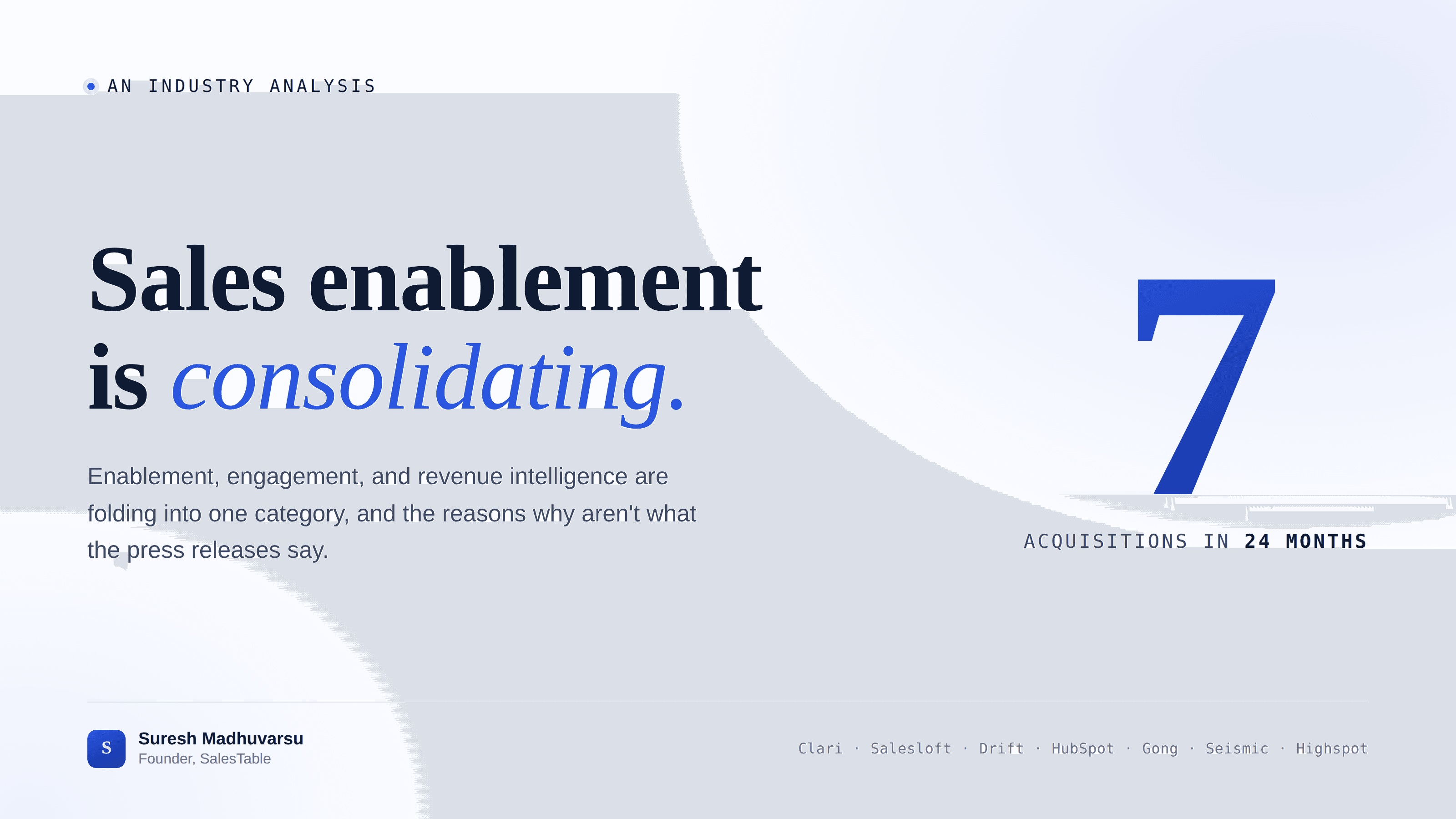
Seven material transactions in roughly 24 months, two more just before that window, across companies that most buyers would have described as being in completely different product categories as recently as 2022.
Wait, are all these companies even in the same category?
This is the question that trips up most outside observers, and it's a fair one. "Sales enablement" gets used as a catch-all, but the market actually has at least five distinct segments, each with its own vendors, its own buyer, and its own budget line:
Content and enablement platforms (Highspot, Seismic, Showpad, Bigtincan) manage the sales playbooks, decks, and battlecards reps use before a conversation happens. This is the oldest and most crowded segment.
Sales engagement and revenue orchestration (Salesloft, Outreach, Drift, Groove) manages the cadence and channel mix of outreach, sequencing emails, calls, and chat across the buyer journey.
Conversation and revenue intelligence (Gong, Clari, Chorus, Wingman) records and analyzes what actually gets said on calls, then rolls that up into forecasting and pipeline visibility.
Coaching, training, and LMS (Mindtickle, WorkRamp, Learning Pool, and a newer wave of AI roleplay tools) handles onboarding, certification, and rep skill development, historically through static courses, now increasingly through simulated practice conversations.
Buyer enablement (Enable Us and similar tools, most now folded into larger platforms) manages digital sales rooms, mutual action plans, and the buyer-facing side of a deal.
Two years ago, a vendor in one of these lanes rarely touched another. Today, almost none of the recent deals respect these boundaries. That's the real story.
Why is Gong buying data, and why did a CRM buy a conversation intelligence company?
This is where it gets interesting, and where most surface-level coverage of these deals misses the point.
The clearest example is actually the one that happened first, and it's worth calling out by name: Clari. Clari built its reputation on forecasting and pipeline visibility, and it didn't stop there. Buying Wingman brought conversation intelligence in-house. Buying Groove brought sales engagement in-house. A company that started as a forecasting tool now sits across three of the five segments described above. That was the opening move in a pattern everyone else has since copied.
Gong built its business recording and analyzing sales calls. Buying RightBound, a company that aggregates account, contact, and buying-signal data from third-party sources, has nothing to do with conversation intelligence in the traditional sense. It's Gong deciding that owning proprietary data about who the buyer is matters as much as owning data about what the buyer said, which is territory that used to belong to enablement and prospecting tools, not conversation intelligence platforms.
HubSpot buying Frame AI runs the same play from the opposite direction. HubSpot is a CRM, the system of record, and CRMs have historically bought data and workflow tools, not AI-native conversation analysis companies. HubSpot's own leadership was explicit about why: AI is only as good as the data feeding it, and unstructured conversational data, the stuff that used to live exclusively inside Gong-style tools, was a gap in HubSpot's own AI strategy.
Salesloft buying Drift moved a sales engagement company into conversational marketing and buyer-side engagement, territory that used to belong to marketing tech, not sales tech. Mindtickle buying Enable Us moved a coaching and training platform into digital sales rooms and buyer enablement, territory that used to belong to content platforms.
Every one of these deals is the same move, just wearing a different company's logo: whoever has the richest first-party data about buyer and seller interaction believes they can build or buy their way into owning the entire revenue stack, not just their original slice of it. The segmentation that made sense in 2020 is dissolving into a single undifferentiated category, something closer to "revenue intelligence platform" than "sales enablement tool," and every vendor above is racing to be the one that owns it end to end rather than owning one lane of it well.
So did any of this actually work?
Here's where I'd urge some patience before drawing conclusions, because the honest answer is that we mostly don't know yet, and won't for a while.
The one deal where we do have real visibility is Salesloft-Drift, and only because of an unrelated event. In August 2025, attackers compromised OAuth tokens tied to the Drift application's integration with Salesforce, Google Workspace, and Slack, then used those tokens to impersonate a trusted app and pull data out of customer environments over roughly a ten-day window. FINRA's own guidance on the incident puts the number at more than 700 affected organizations, with several member firms among them, and names Cloudflare, Palo Alto Networks, and Zscaler among the disclosed victims elsewhere in security industry reporting. That breach forced a level of public scrutiny most of these deals never get, and on March 6, 2026, Salesloft announced Drift itself was being retired, directing customers to a third-party AI avatar product as the recommended replacement. The numbers behind the original deal help explain why the merger happened at all: Vista Equity had acquired a majority stake in Salesloft in 2021 at a reported $2.3 billion valuation, about 23 times revenue, and taken a large position in Drift at a reported $1 billion valuation, both prices that only made sense at the peak of SaaS multiples. By the time of the merger, public SaaS multiples had compressed sharply, into a range several analyses put at roughly 6 to 8 times revenue, leaving Vista holding assets marked well above what the market would actually pay for them separately. The merger looked, in hindsight, more like financial repositioning than product strategy.
But Salesloft-Drift is the exception that proves a broader rule, and it's worth being precise about why. Almost every other deal on this list involves at least one privately held company, several backed by private equity firms that have no obligation to disclose churn, net revenue retention, or integration progress to anyone outside their own investment committee. Showpad and Bigtincan are now owned by Vector Capital. Learning Pool and WorkRamp sit inside Marlin Equity's portfolio. Seismic has been under Permira's control since 2020, and as noted above, its acquisition of Highspot has cleared antitrust review but hasn't been confirmed as fully closed. HubSpot is the one clear exception on this list worth calling out separately: it's a public company that reports results every quarter, made this acquisition from a position of growth rather than distress, and whatever happens with Frame AI's integration into Breeze will actually be visible in a way none of the PE-backed deals will be. That's a meaningful difference, and it's worth not flattening a public company's growth-stage acquisition into the same bucket as a private equity firm merging two underwater portfolio companies to protect a fund return.
For the PE-owned names, the only moment the real numbers surface is when they eventually try to sell, recapitalize, or take one of these combined companies public. That's usually a two to three year horizon from the point of acquisition, which means the honest scorecard on most of 2024 and 2025's deals won't be readable until 2027 or 2028 at the earliest. Anyone telling you definitively today whether Seismic-Highspot or Showpad-Bigtincan "worked" is guessing, and so am I. The right posture here is to watch, not to conclude.
Is the best-of-breed era actually over?
I think so, and I don't think that's a bad thing for AI's role in sales, I think it's the opposite.
For most of the last decade, the pitch to sales leaders was to assemble a stack: a content tool for enablement, a dialer for engagement, a recorder for conversation intelligence, a separate platform for coaching, another for forecasting. Each tool was genuinely good at its one job, and venture capital rewarded exactly that kind of focus. But it meant a rep's AI-generated coaching feedback lived in one tool, their call recordings in another, their content recommendations in a third, and their pipeline risk in a fourth, none of which talked to each other in real time. The intelligence existed, but it was scattered.
The AI moment sales tech is living through right now doesn't work like that. A model that's actually useful to a rep in the middle of a live conversation needs to know what's in the CRM, what was discussed on the last three calls, what content has and hasn't landed with this specific buyer, and what this specific rep tends to get wrong, all at once, not routed through four separate logins. That's not a knock on AI, it's the opposite: it's the clearest evidence yet that AI's value in seller readiness is real enough that fragmentation has become the actual bottleneck. The M&A wave isn't proof that these companies ran out of ideas. It's proof that the market has figured out, all at once, that stitched-together intelligence is worse than unified intelligence, and everyone is racing to own the unified version before someone else does.
What does this mean if you're building something new right now?
If you're a founder, an operator evaluating vendors, or an investor looking at this space, here's the pattern worth paying attention to: every company on the list above is about to spend the next 18 to 24 months doing integration work. Combining two codebases, two data models, two support organizations, and two sales teams is slow, distracting, and historically where the best people leave and the product roadmap stalls. That's not speculation, it's just what happens after every large enterprise software merger, and the Salesloft-Drift experience is a preview of how badly it can go when it's rushed.
That creates a real window. Not for another point solution, the market has made it clear it doesn't want more of those, but for something built natively as one system from day one, rather than five acquired products wearing a shared login page. The companies distracted by integration right now are not going to out-innovate a focused, AI-native entrant during that window. They're going to be in meetings about org charts and API migrations.
Where does SalesTable fit into this?
We started SalesTable because we watched this exact fragmentation problem play out inside enterprise sales, customer success, and pre-sales teams in regulated industries, and we didn't think buying five tools and hoping they'd eventually integrate was ever going to be the answer, no matter how good each individual tool was.
I'm not going to lay out the architecture here, or the roadmap, or the specifics of how we've approached the problem differently. Some of that is exactly the kind of thing that's easy to copy once it's written down, and we'd rather let the product speak for itself when the time is right. What I will say is that we think the winner in this next phase isn't the company with the most acquisitions on its résumé, it's the one whose intelligence was never fragmented to begin with. That's the bet we're making, and it's already showing up in how the teams we work with close and renew deals.
Where this goes next
The consolidation isn't finished. If the pattern holds, expect the AI-native coaching and roleplay startups that haven't been acquired yet, and there are several good ones, to become the next targets, either for the newly merged giants trying to fill a coaching gap or for the revenue intelligence players still hunting for proprietary data. Expect at least one more CRM to make a move into conversation intelligence or engagement, following HubSpot's lead. And expect the real verdict on whether any of this actually served the people using it, the reps, the CS managers, the pre-sales engineers trying to do their jobs better, to take a lot longer to arrive than the press releases suggest.
Zoom out far enough and this entire wave is downstream of one underlying fact: AI is genuinely changing what a seller needs to be good at, automating the simple, transactional end of B2B buying while making the complex, multi-stakeholder, high-trust end more dependent on skilled humans, not less. Every deal on this list is, at bottom, a bet on being the system that makes a human seller better in exactly the moments AI can't yet replace them. Whether any of these combined companies actually deliver that matters far more than who signed which term sheet.
In the meantime, the most useful lens for anyone watching this space isn't "who bought whom." It's "who still has to prove their combined product is better than the sum of its parts," and right now, that list includes almost everyone on it.
Deal dates, valuations, and quotes above are linked to primary sources, company announcements, financial press, and regulatory filings, at first mention. Facts not directly linked were cross-checked against multiple independent reports at the time of writing.
Get the Latest
Join top sales leaders getting insider tips and AI tactics to scale faster, onboard smarter, and sell more.
[Blogs]




“Framer is one of the best web builders I have ever tried. It’s like magic.”
Author